
Why Simi Valley Schools Are Asking Parents for Paper While Superintendent Hani Youssef and His Cabinet Get Raises
Simi Valley Unified is telling families that classrooms need parent “donations” for basics like copy paper, yet the school board just approved hefty pay bumps for Superintendent Hani Youssef and his inner circle. Is the Simi Valley Unified School District truly cash‑strapped, in financial crisis, or have the Board of Trustees fiscal decisions revealed deeply misplaced priorities?
SIMI VALLEY NEWSFEATUREDOPINION
By Adam Loew | June 16, 2026
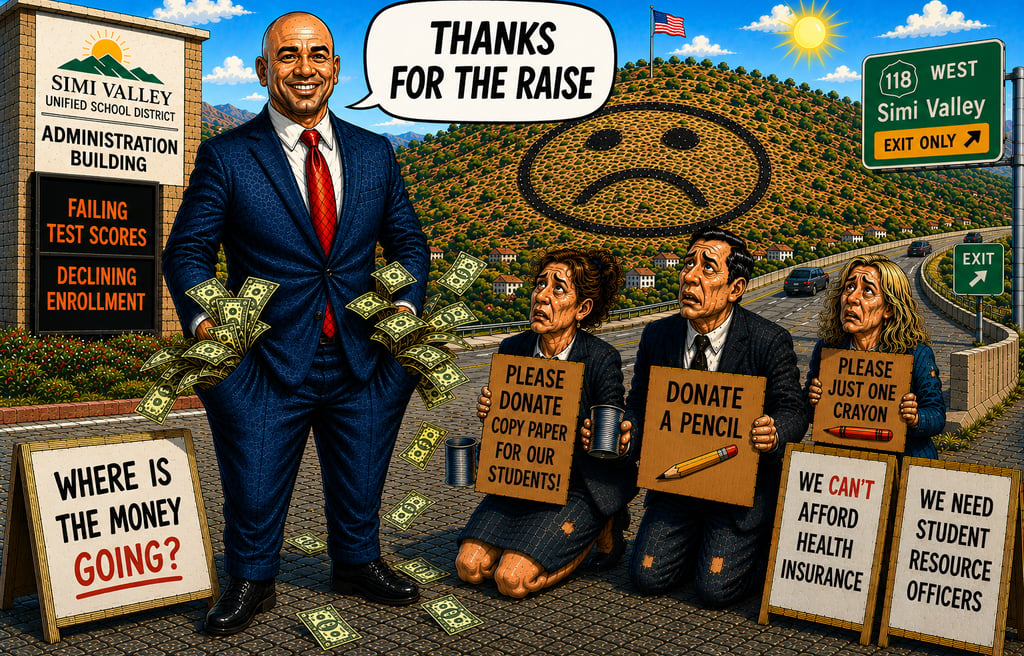
Simi Valley Unified School District is asking parents to help fund basic classroom supplies while simultaneously increasing compensation for its highest-paid administrators. At a time when state test scores are declining, student enrollment continues to fall, and families are being asked to fill budget gaps, the district's spending priorities are drawing increasing public scrutiny.
The controversy centers on a stark contrast: while parents at at least one elementary school were asked to make voluntary monetary donations to help purchase copy paper and other classroom essentials, the school board approved a combined $77,003 in salary increases for the superintendent and members of the senior executive cabinet on June 9, 2026.
Critics argue that the district has created an avoidable public relations and leadership problem by approving executive raises while schools struggle to secure basic supplies needed for daily instruction. For many families, the question is not whether school leaders should be compensated fairly, but whether increasing administrative pay should take precedence when classrooms are relying on parent donations to meet fundamental educational needs.
For many parents and Simi Valley taxpayers, that contrast is hard to ignore. California law allows schools to seek voluntary donations, but supplies, materials, and equipment needed for educational activities must still be provided free of charge, and student participation cannot be conditioned on payment or donations.
ESCALATING EXECUTIVE PAY
On June 9, 2026, Dr. Hani Youssef received an additional $18,814.55, bringing his annual salary to $328,208.68. Under the terms described in this article, his contract runs through June 30, 2030, with a 4 percent annual raise built in.
Those figures matter because they shape public perceptions of the district’s priorities. When executive compensation rises while schools are asking families to contribute toward basic supplies, the board should expect close attention from parents and taxpayers.
The trajectory of Youssef’s compensation tells part of that story. When he was an assistant superintendent in 2021, he earned $186,391. By 2023, as superintendent, he was earning $270,760. His current salary of $328,208.68 reflects an increase of more than $100,000 over four years.
A DONATION LETTER TO FAMILIES
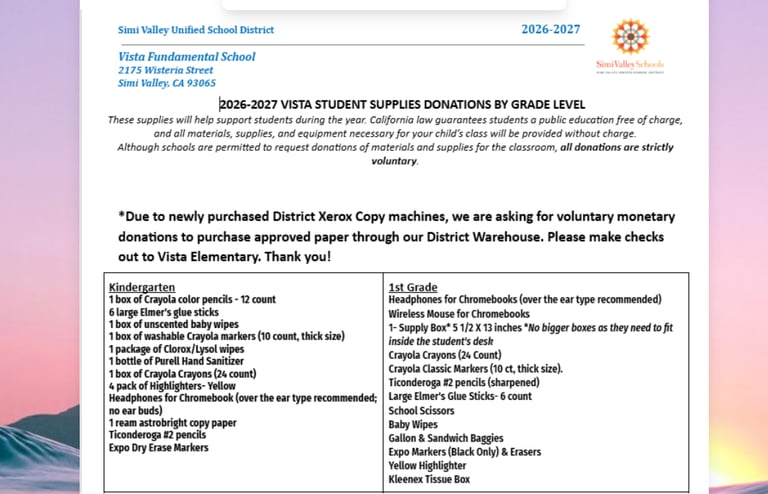
Vista Elementary is a Simi Valley Unified school. According to the letter cited in this article, families were told: “Due to newly purchased District Xerox Copy machines, we are asking for voluntary monetary donations to purchase approved paper through our District Warehouse. Please make checks out to Vista Elementary. Thank you!”
That wording matters. Even when a request is framed as voluntary, it can still raise questions if the items involved are ordinary classroom necessities. California guidance draws a line between permissible voluntary donations and impermissible requirements that families provide materials students need to participate in educational activities.
The issue, then, is not whether schools can ever ask for help. They can. The issue is what it says about district priorities when an elementary school is asking families for paper donations in the same season that top administrators receive substantial pay increases.
WHAT $77,003 COULD BUY
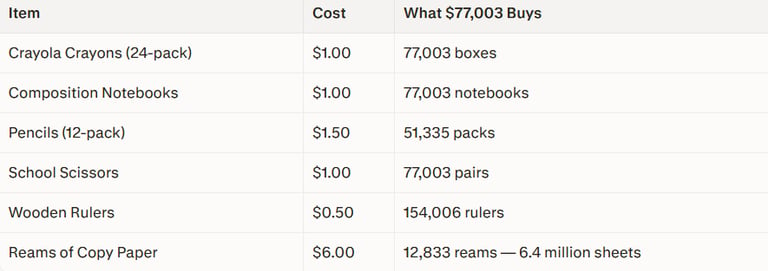
The $77,003 in executive raises is not an abstraction. Simi Valley Unified serves 15,444 students according to multiple public sources. Consider what that amount could have purchased instead:
A basic back-to-school supply kit at approximately $9.67 per student would allow that same amount to cover more than half the district’s enrollment. At $5.00 per student, it would go a long way toward equipping every child in the district with basic classroom tools. These comparisons do not prove wrongdoing. They do, however, illustrate why taxpayers may reasonably question the district’s spending priorities.
CLASSROOM REALITY
For years, teachers in Simi Valley Unified have been expected to do more with less, even as district schools tell families that classroom supplies may be requested as voluntary donations. On school supply lists, those requests include items such as copy paper, tissues, glue sticks, markers, and other shared classroom materials.
A retired Simi Valley Unified School District teacher described how limited classroom support could be in practice:
“I retired last year from an elementary school. We received one case of paper and $100 a year for supplies per class. It should be known at all schools what the teachers receive and how much they have to spend because it is absurd!” — retired Simi Valley Unified School District teacher
That account sharpens the larger debate over district priorities. While district leaders funnel funds to raises rather than to students, families and teachers are still being asked to help fill basic classroom supply gaps, raising a broader question about whether the district is facing real financial strain or making choices that leave classrooms behind.
BIG-CITY PAY IN A SMALL DISTRICT
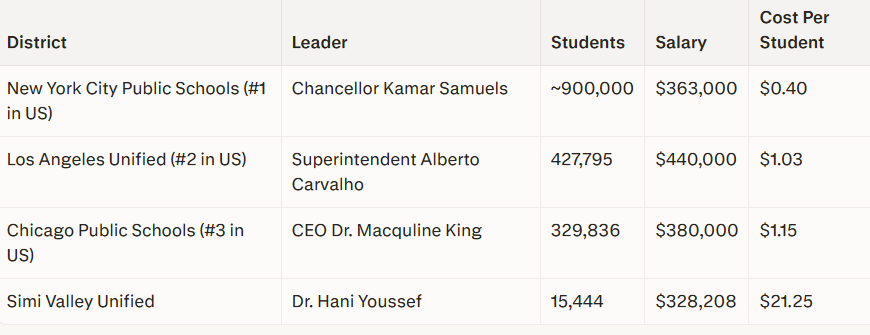
One major issue in Simi Valley is not simply that the superintendent is well paid, but that his compensation is out of scale with the size of the system he leads. To put that in perspective, consider how his salary compares with the leaders of some of the nation’s largest school districts.
New York City, Los Angeles and Chicago all educate student populations that dwarf Simi Valley Unified’s enrollment, yet their top executives earn only modestly more in absolute dollars. When those salaries are translated into a cost per student, Simi Valley’s number stands apart: the superintendent here costs dramatically more per child than counterparts overseeing tens or even hundreds of times as many students.
In an ordinary year, that disparity might be an obscure budget detail. In a year when elementary families are being asked to donate copy paper and classroom supplies, it becomes harder to dismiss. The comparison underscores the central tension in the district’s finances: a compensation structure at the top that looks like big‑city pay, set against school‑level requests that suggest there is not enough money for the basics.
No comparison is perfect, and each district has its own structure and labor market. Still, the disparity is large enough to invite a fair public debate about whether compensation in Simi Valley is aligned with district size, student need, and visible conditions on the ground. On a per‑student basis, Hani Youssef’s salary—about 21 dollars per child—is far out of line with what other large districts spend on their top executives.
CABINET RAISES APPROVED THE SAME NIGHT
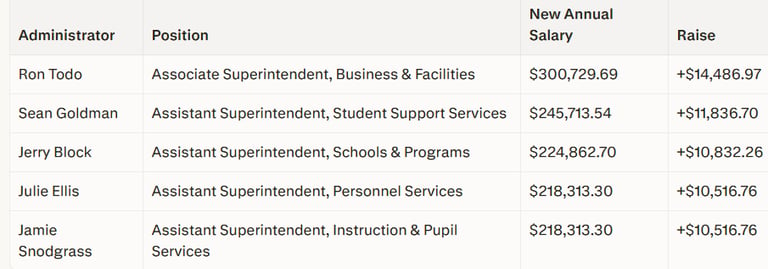
Youssef’s raise was only one part of what the board approved on June 9. New contracts for his senior cabinet were also approved that night:
Together, those increases total $77,003 per year and will recur annually under the approved compensation structure described here. The article also notes that the board preserved the option to grant additional raises retroactive to July 1, 2026.
That context matters because it shows the issue is broader than one individual contract. It is a districtwide compensation decision made at the top of the organization.
BOARD OVERSIGHT AND PUBLIC ACCOUNTABILITY
The votes were recorded and publicly available, and all trustees voted yes on all six agreements, according to the meeting account described in this article. That alone makes the decision a matter of public accountability, not private grievance.
The board’s role is not simply to approve contracts. It is to test them against the district’s overall condition, its obligations to students, and the confidence of the families it serves. When schools are simultaneously asking for voluntary donations for basic supplies, that oversight responsibility becomes more important, not less.
POLITICAL CONSEQUENCES
That vote may carry political consequences for at least two trustees who supported it. Dr. Stephen Pietrolungo faces reelection to the Simi Valley Unified Board of Trustees in November 2026, and Kareem Jubran is running for Mayor of Simi Valley.
Those facts make the June 9 vote more than an internal administrative matter. It is now part of the public record voters will use to judge how these officials define fiscal responsibility and whose interests they place first.
The contrast is troubling even without any allegation of unlawful conduct. It is enough to ask whether district leadership and the board made choices that prioritized executive compensation over public confidence and classroom needs.
THE PRIORITIES QUESTION
Hani Youssef is not a passive observer of the district’s circumstances. As superintendent, he helps set them. He negotiates his compensation, helps shape district priorities, and leads a cabinet whose pay continues to rise, even as at least one district school has asked families for voluntary donations for basic supplies.
That contrast is the heart of the issue. Whatever explanation the district may offer, many parents and Simi Valley taxpayers are likely to see in it a revealing statement about priorities: stability and growth at the top, and fresh requests to families at the classroom level.

The American Federalist is the Official Publication of The Freedom Project © 2026
The American Federalist empowers the generation of tomorrow for a brighter future and hope for every individual.
We are telling America's Story
Subscribe to our newsletter and never miss a story.
We care about your data in our privacy policy.