
Superintendent Neglected Student Safety and S.R.O. Program While Board Approved His Raise
For an entire school year, no police officers were assigned to any of the district’s 28 campuses. Now the superintendent has told city officials he would support a new sales tax on Simi Valley shoppers to bring them back — while the school board that says it cannot pay for officers has approved a multi-year raise package for Hani Youssef and his cabinet. The joint city-district working group studying the tax proposal is meeting outside public view, structured to stay below the quorum threshold that would trigger California’s open-meeting law.
SIMI VALLEY NEWSFEATUREDOPINION
"Raising taxes is a sign of a failure to plan and prepare.” — Richard Perini, candidate for the District 2 City Council seat
SIMI VALLEY, Calif. — For the entire 2025-26 school year, no police officer was assigned to any of the 28 campuses in the Simi Valley Unified School District, a system serving more than 15,000 students from kindergarten through 12th grade.
The Simi Valley Police Department once stationed sworn officers on those campuses as school resource officers. That program, according to reporting by The Simi Valley Acorn, fell to zero after one officer retired and another went on leave. Neither was replaced.
Now the district’s superintendent, Dr. Hani Youssef, has indicated to city officials that he would support asking Simi Valley voters to approve a new citywide sales tax to help pay to put officers back on district campuses, according to statements delivered on the record to the City Council by the city manager, Samantha Argabrite.
The disclosure sits alongside two decisions the school board made on June 24: the adoption of a $255 million operating budget, and a vote to shelve — but not abandon — a facilities bond it had been preparing for the November 2026 ballot, according to a second Simi Valley Acorn account of the meeting. Together, the two actions leave open the possibility that Simi Valley residents will be asked in 2028 to approve two tax measures at once: a city sales tax for school safety, and a school district bond for facilities.
Ms. Argabrite told the City Council this month that she had spoken directly with Dr. Youssef about the cost of campus safety. The district, she said, “indicated a willingness to explore cost-sharing” with the city and had “discussed a possible voter-approved increased sales tax measure” to fund school safety, according to The Acorn’s account of her remarks.
The city does not operate the schools. Under California Education Code § 32280, campus safety is the responsibility of the school district. Under the framework Ms. Argabrite described, the cost of that responsibility would move from the district’s $262 million budget to a levy paid by every shopper in the city.
A sales tax increase would also raise the cost of goods at every register in Simi Valley, a burden that would fall on local businesses as well as their customers. Retailers, restaurants and small businesses that already compete with online sellers and with lower-tax jurisdictions nearby would see the total price of their goods rise relative to those alternatives, without any change in what they earn on each sale.
The joint city-district working group now studying that proposal is meeting outside public view. The two-member cap on school board participation was Dr. Youssef’s design. At the June 9 school board meeting, he told Trustee Kareem Jubran that the district could not send more than two of its five trustees to the working group, because a third appointee would constitute a quorum of the board and would trigger the Brown Act’s open-meeting requirements. The board proceeded to appoint two trustees, Board President Dawn Smollen and Trustee Stephen Pietrolungo, and no more.
A District’s Job
In most California cities, school districts that want officers on their campuses reimburse the local police agency for the cost. The Simi Valley Police Officers’ Association, which represents the officers who would staff the program, described that model in a public statement, noting that “neighboring communities fund their S.R.O. programs through partnerships with their school districts.”
The arrangement Ms. Argabrite outlined would depart from that model. Rather than the district reimbursing the city, the city would raise new tax revenue from residents to underwrite a service the state has assigned to the district.
Ms. Argabrite did not identify a rate, an effective date, or a proposed ballot cycle for the sales tax measure in her remarks to the council.
How the Program Reached Zero
The end of the school resource officer program did not follow a cut in state funding or a vote by the City Council, according to The Acorn’s reporting. It followed the departures of two officers whose absences were foreseeable: a retirement and an extended leave. There is no public record of the district requesting interim coverage from the Police Department, submitting a backfill plan to the school board, or publicly pressing for a stopgap while a long-term solution was negotiated.
The May 11 Working Group
On May 11, the Simi Valley City Council appointed two of its members, Joseph Ayala and Mike Judge, to a joint working group with the school district and the Police Department. The panel’s charter, as described to the council, is to study “whether a cost-sharing partnership between the city and school district is needed.”
The school board did not name its two representatives until nearly a month later. On June 9, it appointed Ms. Smollen and Mr. Pietrolungo.
Mr. Judge, a councilmember who is running for mayor in the Nov. 3, 2026 general election, has taken a public position on staffing but not on the tax question. “Three is a nice number,” he said, “but four would be the optimum number for S.R.O.s.”
The working group’s four-member structure — two councilmembers and two trustees, each side less than a majority of its parent body — places its meetings in a legally contested zone under the California Ralph M. Brown Act, the state’s open-meeting law. Advisory committees composed of less than a quorum of a single legislative body generally are not required to hold public meetings. But when a joint committee is created by formal action of two agencies and functions as a single body — rather than as two separate subcommittees reporting back to their parents — California courts have held that it may itself become a legislative body subject to the Act, according to guidance published by the First Amendment Coalition, a nonpartisan open-government legal group. The controlling case, Joiner v. City of Sebastopol (1981), found that a similarly structured joint committee of two councilmembers and two planning commissioners was a legislative body under the Act.
The Simi Valley working group’s meetings are closed to the public. Neither the city nor the school district has posted a public meeting agenda for the group, and neither has publicly confirmed a date, time, or location at which residents may attend.
A Cost Transfer, Not a Partnership
A city sales tax, if adopted, would be paid by every shopper in Simi Valley, including residents with no children in the schools, retirees on fixed incomes, and small businesses. It would also move the cost of school policing away from the agency that makes the staffing, program and discipline decisions affecting those officers’ work — and place it on taxpayers who do not vote in school district elections.
The school board has not voted in public on whether to support a sales tax measure. Ms. Argabrite’s account, delivered to the City Council, is the only public record so far of the superintendent’s position. Dr. Youssef did not respond to requests for comment submitted to his office.
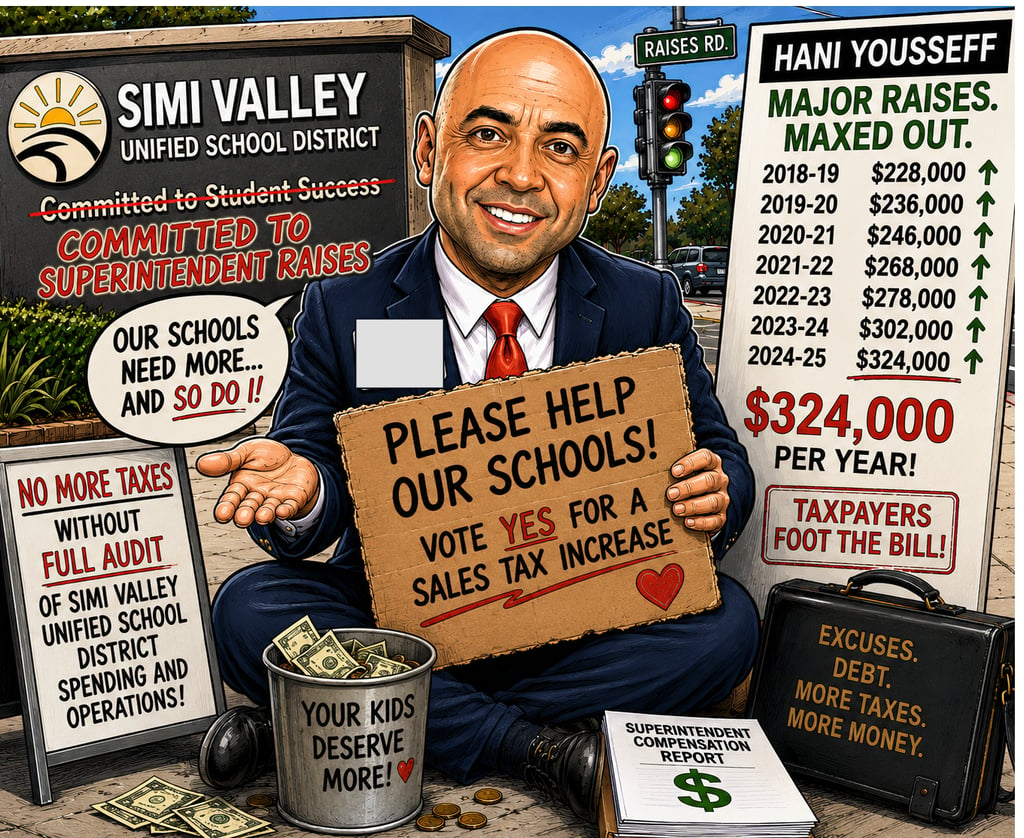
At the June 24 meeting, the same board that has now been described as unable to fund officers from its own budget adopted a management compensation package that increases the pay of the district’s senior administrators. The package raises salaries for the management tier by 2 percent on-schedule and 1 percent off-schedule in the 2025-26 school year, with additional 2 percent raises in each of the following two school years, according to the district’s Second Interim Budget. That tier includes the superintendent and his cabinet.
The vote was cast by the members of the SVUSD Board of Trustees. Mr. Jubran, the board’s clerk and a candidate for mayor of Simi Valley, was among those voting.
The most recent year for which the administrators’ compensation appears on the public record is 2023, published by Transparent California. In that year, the district’s superintendent and five cabinet members received the following total compensation, including benefits:
Dr. Hani Youssef, superintendent — $324,200
Ron Todo, associate superintendent for business and facilities — $339,006
Sean Goldman, assistant superintendent for student support services — $278,998
Julie Ellis, assistant superintendent for personnel services — $254,861
Jerry Block, assistant superintendent for schools and programs — $238,320
Jamie Snodgrass, assistant superintendent for instruction and pupil services — $231,940
Together, the six positions cost the district more than $1.66 million in 2023. That figure does not include the raises approved this June or the increases scheduled through 2028.
Candidates Weigh In
Five candidates running in the Nov. 3 general municipal election — one for mayor and four for City Council — have publicly opposed the sales tax framework.
Mike Judge, the councilmember serving on the working group, is among them. “I believe that all Californians are taxed too much,” Mr. Judge wrote in a Facebook post, a copy of which was retained by this reporter. “Already burdening the people of Simi Valley with more taxes before every other option is exhausted, and this is incompetent. I am positive another way can be found.”
Richard Perini, a candidate for the District 2 council seat, wrote on Facebook: “Raising taxes is a sign of a failure to plan and prepare.”
Jill Abele, a candidate for City Council, drew a distinction between supporting officers and supporting a new tax to pay for them. “I do not support either an increase to our sales tax nor [sic] the proposed T.O.T. tax,” she wrote in a public Facebook comment, adding that the city already has “the resources to assure adequate staffing levels, full training and the equipment needed to support our officers.” Her reference to the transient occupancy tax — a levy on hotel and short-term lodging stays — indicated that a second revenue proposal, beyond the sales tax Ms. Argabrite disclosed, was in circulation.
Ivana Christmann, a Simi Valley planning commissioner and City Council candidate, said the answer was economic growth, not a new tax. “My platform is on economic development so we can afford all of that and to fix our streets, lights, etc.,” she wrote, adding that she was “not for a tax increase in any shape or form.” Ms. Christmann also noted that “our officers just got a raise,” referring to a compensation increase the city has already granted its sworn officers without a new tax to fund it.
Sam Cohen, also a candidate for the District 2 seat, argued in a written statement that the city should look inside its own budget before it looks to the ballot. “Fiscal discipline, aggressively going after state and federal grants and prioritizing safety and infrastructure — because it’s cheaper to keep up than catch up — are all super efficient, forecastable and transparent ways to avoid new taxes,” he wrote.
Mayor Dee Dee Cavanaugh, who is running for a full term, and mayoral candidate Kareem Jubran, who is also a sitting school board trustee, did not respond to requests for comment sent through their campaign contacts.
News Analysis: The Case for an Audit Before a Tax
The framework Ms. Argabrite described to the City Council would ask Simi Valley voters to underwrite, at the register, a service the state has assigned to their school district. Before that question reaches the ballot, three sets of numbers warrant scrutiny.
The first is enrollment. Simi Valley Unified served roughly 22,000 students at its peak in 2003, according to Ballotpedia’s compilation of federal enrollment data. By 2025-26 that figure had fallen to 15,081 — a loss of nearly one in three students in a generation. The district still operates 28 campuses. State funding follows students; overhead does not.
The second is academic performance. On the most recent state assessment, 50.21 percent of Simi Valley Unified students met or exceeded state standards in English language arts. In mathematics, 36.67 percent did. Both figures were up modestly from 2024, but nearly half of the district’s students are not reading at grade level, and nearly two-thirds are not performing at grade level in math.
The third is cost. The district’s $255 million operating budget, its 28-campus footprint, and its senior-management payroll — before the raises the board approved this June take effect — describe an organization whose fixed costs have not fallen at the rate of its enrollment.
Those numbers, taken together, raise questions about whether the district’s fiscal position is a revenue problem or a structural one. Candidates in the coming municipal election have called for the answers to come before the tax question does. Mr. Cohen’s statement about “fiscal discipline” and “aggressively going after state and federal grants,” and Ms. Christmann’s argument for growing the economy rather than the tax base, both point toward the same idea: that the district’s operations warrant independent review before its request for new revenue is put to voters.
Mr. Perini put the point more bluntly. “Raising taxes,” he wrote, “is a sign of a failure to plan and prepare.” Applied to the school district he was addressing, his standard invites a direct question: did Dr. Youssef’s administration plan and prepare for the safety of Simi Valley students? The record on that question is what the piece above documents — a retirement and an extended leave, both foreseeable; no public record of a backfill plan; a school year that ended with zero officers on 28 campuses; and now a request that voters pay a new tax to reverse the outcome. By the standard Mr. Perini articulated, the answer is not favorable to the administration.
Such a review would ask questions the school board has not addressed in public. Whether a shrinking district still needs 28 open campuses, or whether school consolidation would reduce overhead. What facilities management costs per square foot, and how those costs compare with peer districts. Why enrollment has continued to fall — how much reflects declining birth rates statewide, and how much reflects families choosing charter schools, private schools or other districts because of academic results. And where, line by line, the $255 million operating budget goes.
Those are questions an outside audit — one not commissioned by the same administration whose spending it would examine — is designed to answer.
If the answers show that the district cannot, in fact, deliver campus safety and repair its buildings from a $255 million budget serving 15,081 students, then the sales tax and the school bond will deserve a fair hearing. If they show something else — that a shrinking district has been paying senior administrators near the top of the market while academic outcomes stall and buildings decay — then the ballot question voters will face is not, in the end, about a tax rate. It is about whether the leadership that produced those numbers is the leadership that should be asked to spend more of the public’s money.
Until an independent audit produces those answers, the argument for saying yes to either measure remains, on the public record, incomplete.
Sources: Simi Valley Acorn, “Leaders explore long-term funding for school safety,” June 13, 2026; Simi Valley Acorn, “Simi Valley Unified approves $255 million budget, shelves November facilities bond”; Transparent California — Simi Valley Unified School District salaries; SVUSD 2025-26 Second Interim Budget; SVUSD District Leadership; California Education Code § 32280; Simi Valley Police Officers’ Association statement on SRO staffing; EdData — Simi Valley Unified enrollment 2025-26; EdSource — Simi Valley Unified 2025 CAASPP Smarter Balanced results; Ballotpedia — Simi Valley Unified enrollment history; California Ralph M. Brown Act, Cal. Gov. Code §§ 54950–54963; First Amendment Coalition — guidance on joint committees under the Brown Act; SVUSD Regular Meeting of the Board of Trustees, June 9, 2026, video archive.
The American Federalist is the Official Publication of The Freedom Project © 2026
The American Federalist empowers the generation of tomorrow for a brighter future and hope for every individual.
We are telling America's Story
Subscribe to our newsletter and never miss a story.
We care about your data in our privacy policy.