Hidden Numbers, Higher Taxes: The Transparency Questions Behind SVUSD’s 2026 Bond
Simi Valley Unified School District is considering a 2026 school bond that could increase property taxes, but the district acknowledges it does not possess the raw data behind the voter survey used to measure support. The lack of independent access to the poll results, combined with questions about survey methodology and consultant compensation, has raised concerns about transparency, accountability, and public trust.
FEATUREDSIMI VALLEY NEWS
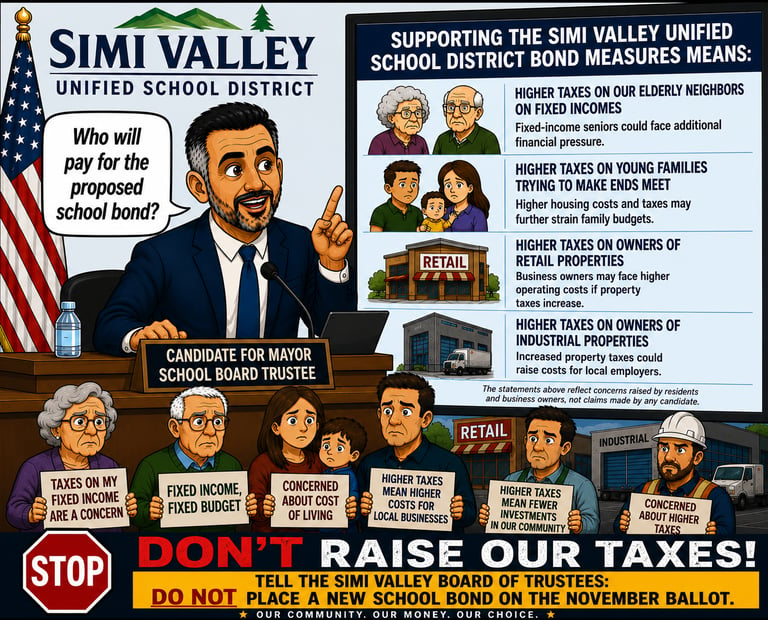
Simi Valley Unified School District’s push for a 2026 school bond is not just a debate about facilities. It is a proposal to raise property taxes to repay long-term debt, affecting homeowners, families, seniors on fixed incomes, and owners of commercial and industrial property throughout Simi Valley. In California, local school general obligation bonds are repaid with ad valorem property taxes levied on property within the Simi Valley Unified School District, which covers most property within the City of Simi Valley. Proposition 39 allows those taxes to exceed the usual 1-percent limit when voters approve a school bond. For seniors, counties note that there are generally no exemptions from school bond taxes because they are ad valorem charges, unlike some school parcel taxes that may offer senior exemptions.
Those costs would not remain confined to the annual residential property tax bills. Commercial and industrial property owners also pay these taxes, and higher property-related costs can flow through into higher rents, higher business expenses, and ultimately higher prices paid across the local community. Against that backdrop, Simi Valley Unified School District’s reliance on a survey whose raw data it does not possess raises fundamental questions about transparency, public trust, and whether the community is being asked to support a tax increase based on numbers it cannot independently examine.
A Bond Built on Hidden Numbers
In late 2025, Simi Valley Unified School District moved to test voter support for placing a new bond measure on the 2026 ballot, hiring Isom Advisors to conduct a phone-based poll of voters. According to the district’s November 2025 board materials, the poll was intended to determine whether there was sufficient support to move forward with a bond measure, and, if so, the same consulting relationship would continue into financial planning and bond issuance work.
That makes the poll more than a routine public-opinion exercise. It is the gateway to a possible tax increase and the first step in a larger bond program that could generate significant follow-on work for the same consultant.
District Lacks Raw Data
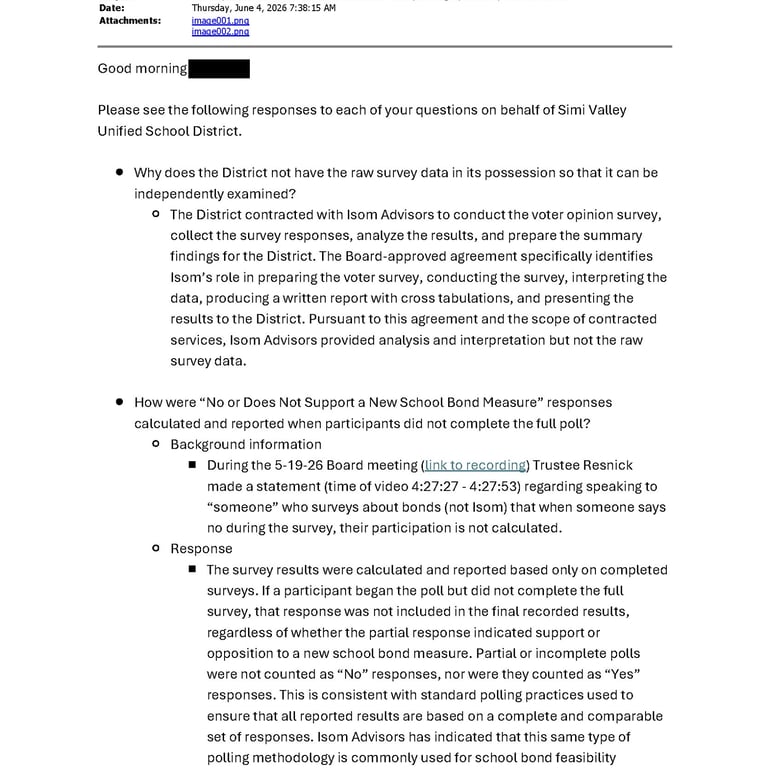
The central problem is simple: the district lacks the underlying poll data. In a June 4, 2026, email sent in response to questions submitted to the Simi Valley Unified School District Board of Trustees, attorney Rebecca Nelson responded on behalf of Simi Valley Unified School District. She confirmed that SVUSD does not have the raw poll results in its files.
Nelson explained that the district contracted with Isom Advisors to design the survey, collect responses, analyze the results, and prepare summary findings with cross-tabulations. “Pursuant to this agreement and the scope of contracted services, Isom Advisors provided analysis and interpretation but not the raw survey data,” she wrote. That means no outside auditor, journalist, trustee, or resident can independently review how many calls were made, how many respondents dropped off, where they lived, or how support changed during the poll.
Resnick’s Concern Confirmed
The lack of raw data matters even more because it directly relates to a publicly raised concern by Trustee Dr. Ronald Resnick. At the May 2026 board meeting, Resnick said he had spoken with a professional involved in bond polling who described a method in which a participant who says “no” and then disengages is not counted in the final tally.
Nelson’s written response confirmed that the SVUSD poll results “were calculated and reported based only on completed surveys.” If a participant began the poll but did not complete the full survey, that response “was not included in the final recorded results, regardless of whether the partial response indicated support or opposition to a new school bond measure.” She added that partial or incomplete polls “were not counted as No responses, nor were they counted as Yes responses,” describing that approach as standard practice for school bond feasibility surveys.
Why It Matters
On paper, counting only completed surveys may sound like a neutral methodological choice. In practice, however, it can erase early opposition from the reported results if a voter rejects the bond and hangs up before finishing the full questionnaire.
Because SVUSD never obtained the raw call data, the public has no way to know how many respondents may have expressed opposition and then dropped out, or whether those incomplete interviews followed a meaningful pattern across neighborhoods, age groups, or political affiliations. Without that data, residents cannot test whether the reported support level was inflated by a process that excludes some of the strongest early “no” responses.
The Lucrative Fee Ladder
The district’s relationship with Isom Advisors extends beyond the survey itself. Under the broader consulting agreement, Isom was retained not only for voter polling but also for financial planning, financial advisory services, continuing disclosure work, and annual debt transparency reporting tied to a future bond program.
The poll is paid from the district’s general fund and is not contingent on an election outcome, but larger downstream fees become available if a bond program moves forward and bonds are sold. The agreement lists up to $ 12,500 for Survey/Voter Opinion Services, while the latter 2025 board item lists survey services at up to $ 17,500. It also provides 30,000 dollars for Financial Planning Services, up to 77,500 dollars in Financial Advisory fees for each series of bonds sold, 3,000 dollars per year for Continuing Disclosure Services, 250 dollars per filing for Annual Debt Transparency Report services, and up to 2,500 dollars in reimbursable expenses.
That means the survey the public cannot independently review serves as the front-end trigger for a consulting chain for Isom Advisors that can easily exceed $ 100,000 over the life of a bond program, depending on how many bond series are ultimately issued.
Conflict Concerns
The district has defended the arrangement. In the same June 4 response, Nelson said the agreement discloses potential conflicts of interest and states that Isom owes fiduciary duties of care and loyalty to the district. She also argued that Isom does not get paid simply because a bond is placed on the ballot, and that it would have no practical reason to manipulate polling, as failed measures and inaccurate forecasting would damage the firm’s reputation.
But the consulting agreement itself contains unusually direct language of conflict. It states that contingent and transactional compensation “may present a potential conflict of interest” by creating “an incentive for the Advisor to recommend unnecessary financings or financings that are disadvantageous to the District, or to advise the District to increase the size of the issue.” The same agreement also says Isom may perform non-municipal advisory work, including bond ballot services. It defines those services as including campaign strategies, voter communication, campaign budgets, mailers, flyers, handouts, get-out-the-vote activities, and donations.
What Policy Analysts Say
Viewed in that light, Simi Valley’s situation fits a broader pattern critics have described in school bond politics. California Policy Center analysts have argued that the system for proposing and passing local bond measures is structured to favor passage, with consultants using polling to identify which words and arguments are most effective with different groups of voters and then converting that research into targeted messaging.
That critique matters here because Isom’s own agreement contemplates both feasibility polling and related bond ballot services within the same overall relationship. When a consultant helps measure voter tolerance, shape tax-rate messaging, recommend bond size, prepare ballot language, and potentially provide campaign-related services, the line between neutral research and advocacy can become difficult for the public to see.
Political Stakes for Trustee Kareem Jubran
The controversy could also carry political consequences beyond the bond debate itself. Trustee Kareem Jubran is publicly running for mayor of Simi Valley while also serving on the school board, making his position on any future bond measure potentially relevant to city voters as they weigh his judgment and priorities.
If Jubran is seen as supporting a school bond that raises property taxes on Simi Valley residents, especially homeowners, seniors on fixed incomes, and local businesses, that stance could become a line of attack in a mayoral race. The political risk would deepen if the district’s feasibility survey is ultimately viewed as incomplete, misleading, or tilted toward passage, and if residents conclude they were being asked to support a tax increase without reliable proof of actual public support. In that scenario, backing the bond could become a serious liability for a candidate seeking citywide office.
Public Trust
Taken together, the issues are hard to dismiss as a minor procedural dispute. The district is considering a property-tax-backed bond, relying on a consultant-controlled survey, excluding incomplete interviews from the reported results, and failing to provide the raw data needed for independent review.
Isom Advisors has not been shown to have falsified anything, nor does this article suggest that Isom has acted improperly. It is that the public is being asked to consider a long-term tax burden through a process in which key figures cannot be verified externally. For a district seeking public trust before asking voters to approve decades of repayment obligations, that is not a technical footnote. It is the story.
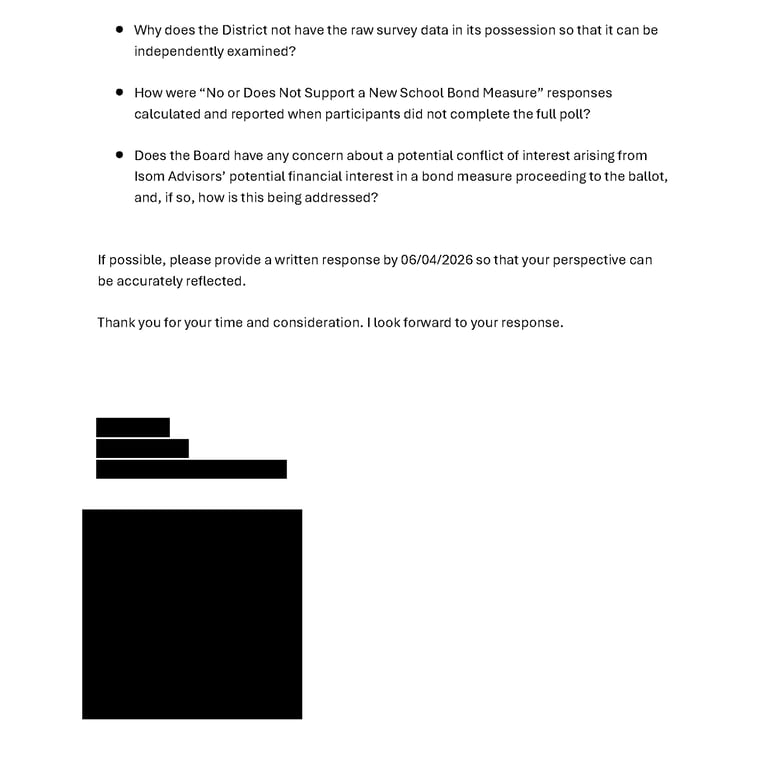
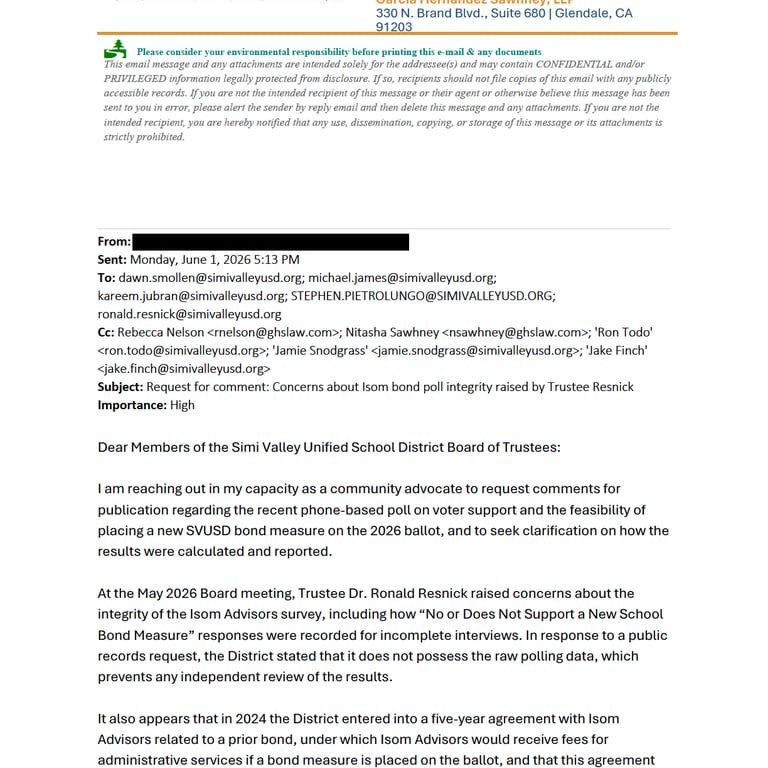
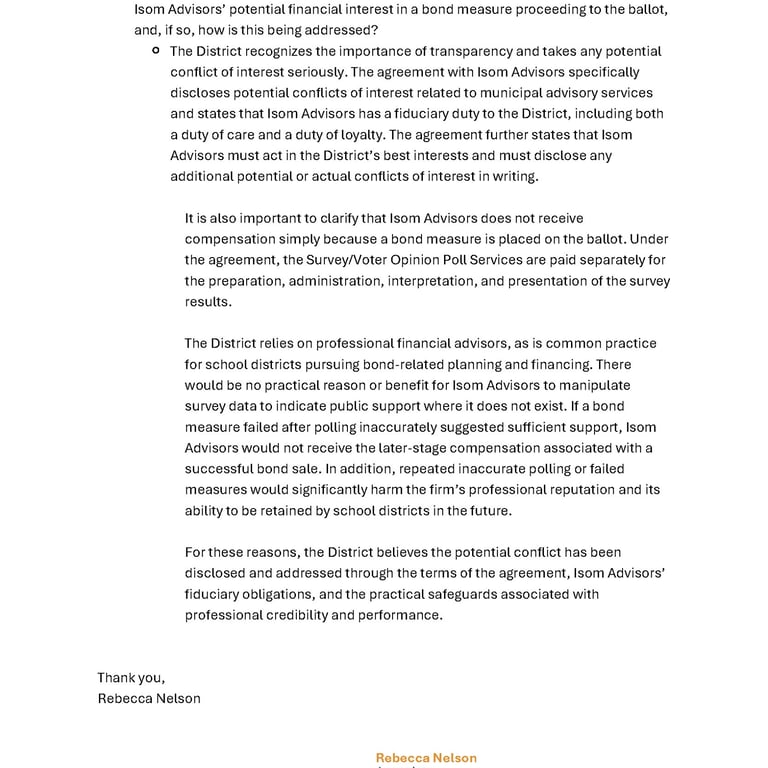
PRA Responses From Simi Valley Unified Board of Trustees
(Click to Expand)
The American Federalist is the Official Publication of The Freedom Project © 2026
The American Federalist empowers the generation of tomorrow for a brighter future and hope for every individual.
We are telling America's Story
Subscribe to our newsletter and never miss a story.
We care about your data in our privacy policy.